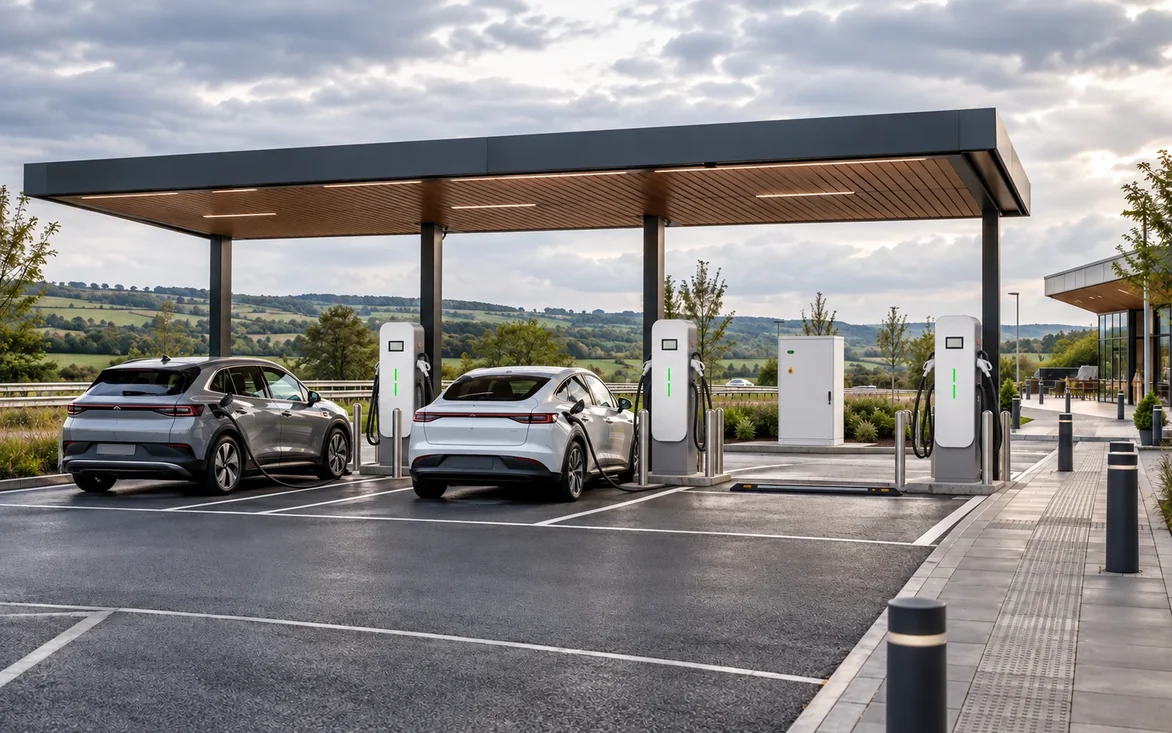
DC FAST CHARGERS · 120–480kW
Fast Charging for Public Networks, Fleets and High-Utilization Commercial Sites.
A scalable DC range covering 120kW, 160kW, 240kW and 480kW integrated charger applications, with configuration choices based on vehicle voltage, current demand, connector mix and site power.
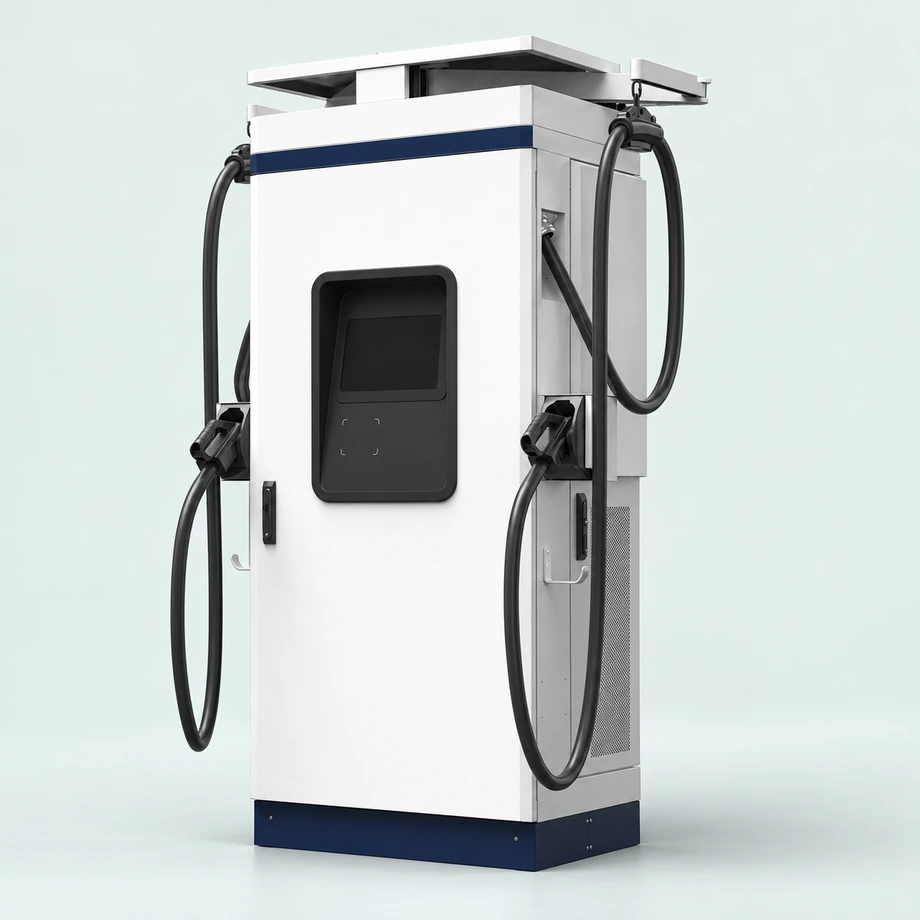
PRODUCT OVERVIEW
A Scalable DC Range for Public and Fleet Charging.
The 120–480kW range covers common public fast-charging and fleet applications. Final configuration should be selected around the vehicle voltage platform, charging current, connector mix, simultaneous sessions and available site power.
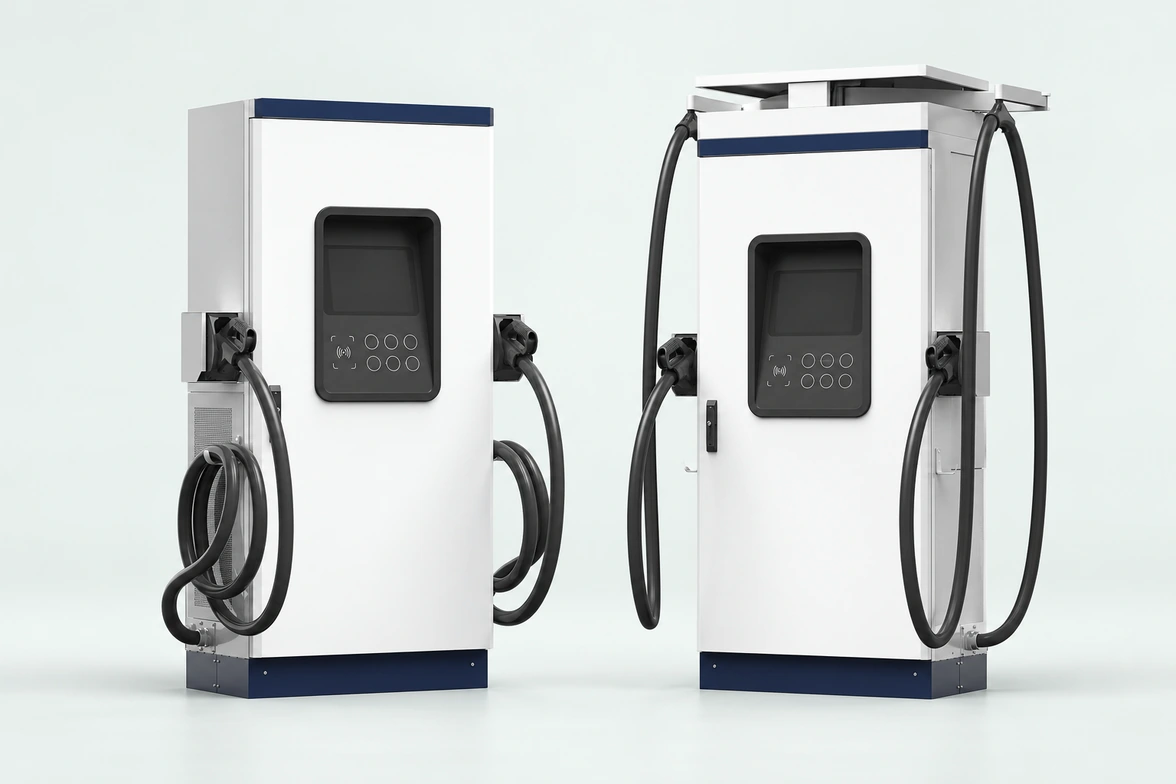
60–160kW · Four-slot cabinet
750 × 435 × 1700mm (W × D × H). Up to four module positions, with 30kW or 40kW modules selected for the quoted configuration. Standard cable storage and optional overhead retractors are shown.
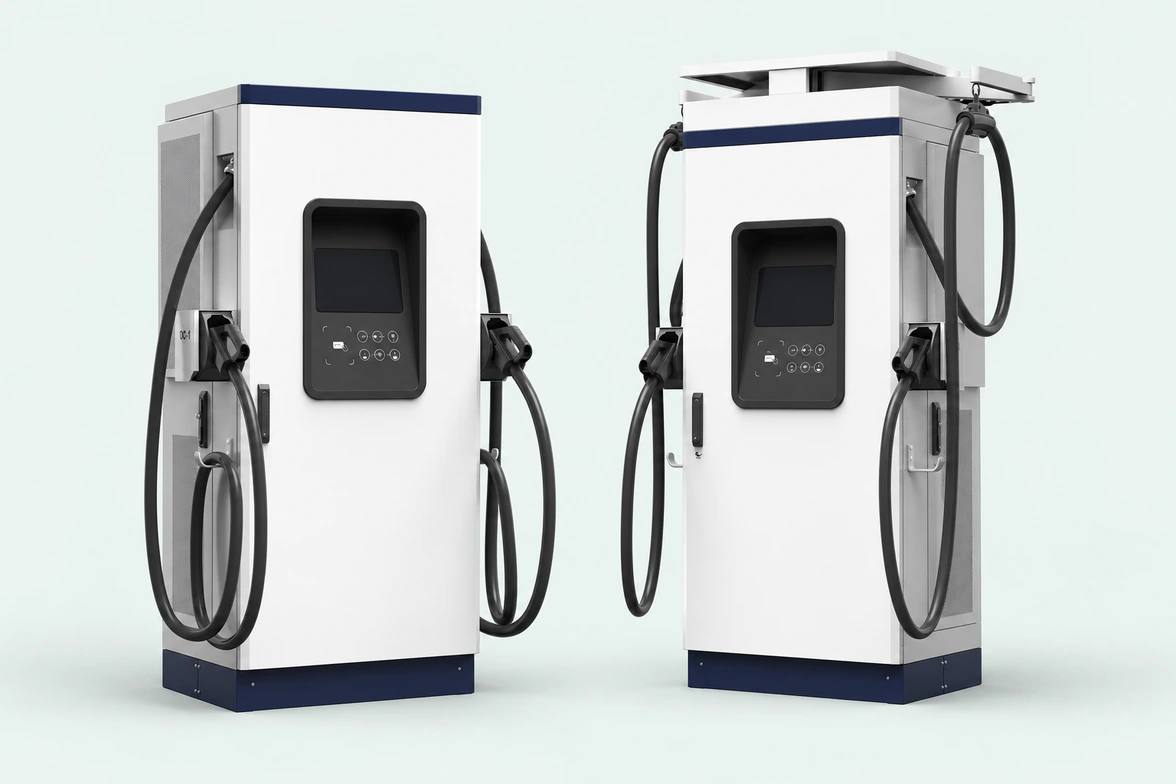
160–240kW · Six-slot cabinet
750 × 540 × 1700mm (W × D × H). Up to six module positions, using 40kW modules. Module population and operating limits depend on the selected 160kW, 180kW or 240kW configuration. Standard and optional cable management are shown.
The two cabinet families shown here cover 60–240kW configurations. Images of the 480kW integrated platform will be added separately; it is not represented by either cabinet above. Final power, module population and connector configuration are confirmed in the project quotation.
Power Range and Use Cases
120kW
A practical entry point for public charging, ride-hailing and fleet sites where moderate fast-charging power fits the vehicle and site.
160kW
For projects that need a step up in power while keeping an integrated charger format and conventional site layout.
240kW
For higher-utilization public and fleet sites where vehicles and the electrical system can make effective use of the additional output.
480kW
An integrated higher-power option for demanding public and fleet sites. Confirm the model-specific output, connector, cooling, electrical supply and installation requirements before selection.
Typical Applications
Public Charging
CPOs, fuel stations, urban fast-charging sites and corridor locations.
Fleet Charging
Ride-hailing, logistics and commercial fleets with defined charging windows and repeatable daily demand.
Commercial Fast Charging
High-utilization commercial sites where faster vehicle turnover supports the operating model.
Parallel Expansion
Selected 120kW platforms can be configured for parallel operation where the project requires higher output and the system architecture supports it. Final parallel-control logic and supported configurations must be confirmed for the selected equipment.
Technical Information
The specifications below cover the 120 / 160kW four-slot cabinet and 160 / 180 / 240kW six-slot cabinet documented in the supplied technical sheets. The two 160kW configurations use different cabinet depths. Other power configurations, including 480kW integrated platforms, require separate technical confirmation.
Four-Slot Cabinet: 120 / 160kW
| Parameter | 120kW | 160kW |
|---|---|---|
| Rated DC power | 120kW | 160kW |
| Installed power modules | 4 × 30kW | 4 × 40kW |
| Module slots | 4 | 4 |
| Dimensions (W × D × H) | 750 × 435 × 1700mm | 750 × 435 × 1700mm |
| Weight incl. modules | 260kg | 266kg |
| Max. efficiency | >95.5% | >96.5% |
| Max. DC current | 300A | 300A |
| Max. AC current | 194A | Confirm configuration |
| Noise | <60dB | <60dB |
| Operating temperature | −30 to +70°C | −30 to +70°C |
| Listed conformity | CE / CB / OCA | OCA; other approvals on request |
Six-Slot Cabinet: 160 / 180 / 240kW
| Parameter | 160kW | 180kW | 240kW |
|---|---|---|---|
| Rated DC power | 160kW | 180kW | 240kW |
| Installed power modules | 4 × 40kW | 5 × 40kW | 6 × 40kW |
| Module slots | 6 | 6 | 6 |
| Dimensions (W × D × H) | 750 × 540 × 1700mm | 750 × 540 × 1700mm | 750 × 540 × 1700mm |
| Weight incl. modules | 272kg | 289kg | 306kg |
| Max. AC current | 258A | 291A | 388A |
| Max. efficiency | >96.5% | >96.5% | >96.5% |
| Noise | ≤65dB | ≤65dB | ≤65dB |
| Operating temperature | −30 to +50°C | −30 to +50°C | −30 to +50°C |
| Listed conformity | CE / CB / OCA | CE / CB / OCA | CE / CB / OCA |
Shared Electrical & Environmental Specifications
| Parameter | Specification |
|---|---|
| AC supply | 380 / 400Vac ±10% · 3P + N + PE |
| Input frequency | 45–65Hz |
| Power factor | >0.99 |
| Input THDi | <3%, rated input |
| Standby power | 30W |
| Constant-power range | 300–1000Vdc |
| Full-power temperature | Up to +50°C |
| Cooling | Air cooled |
| Protection | IP55 / IK10 |
| Storage temperature | −40 to +75°C |
| Relative humidity | ≤95% RH, non-condensing |
| Altitude | 2000m |
| Atmospheric pressure | 80–110kPa |
Connector & Output Configuration
| Connector | Four-slot cabinet | Six-slot cabinet |
|---|---|---|
| CCS2 voltage | 150–1000Vdc | 150–1000Vdc |
| CCS2 cable options | 200 / 250 / 300A | 250 / 325 / 375A |
| GB/T cable rating | 250A | 250A |
| CHAdeMO cable rating | 150A | 150A |
| GB/T voltage | Confirm selected option | 150–950Vdc |
| CHAdeMO voltage | Confirm selected option | 150–500Vdc |
| Connector quantity | 2 | 2 |
Control, Metering & Options
| Parameter | Specification |
|---|---|
| Backend protocol | OCPP 1.6J |
| Network interfaces | LAN / LTE modem support |
| CCS communication | DIN 70121 / ISO 15118 |
| CHAdeMO protocol | Version 1.2 |
| Four-slot display | 7-inch; optional 10.1-inch |
| Six-slot display | 7 / 10-inch, selected configuration |
| Status / emergency stop | 3 RGB LEDs / emergency stop |
| Metering | DC meter · GB/T 29318 / JJG 1149 |
| MID-certified meter | Optional |
| User access | RFID / mobile app |
| POS payment | Optional |
| Cable management | Optional twin top retractors |
| Dynamic power allocation | Optional switching matrix |
| Inter-charger power transfer | Optional; project-specific |
| Maintenance | Web / app backend |
| Voltage / current protection | Over / undervoltage, overcurrent |
| Insulation / earth monitoring | Supported |
| Additional protection | Short circuit / polarity / temperature |
| Input contactor protection | Supported |
Each charger shares its rated power across its active connectors. Optional inter-charger transfer requires compatible hardware and an approved configuration; it does not guarantee the combined power at every vehicle. Firmware upgrades to OCPP 2.0x, OTA, Plug & Charge, smart charging and power management depend on the selected firmware, vehicle and backend. Listed electrical standards include EN 61851-1 / -23 / -24 and EN 61851-21-2 Class A; GB/T versions refer to the 2015 standards. Request configuration-specific certificates. Derating applies above +50°C only within the approved operating range; confirm the model-specific curve.
Configuration Comes Before Price.
- 01Vehicle Profile
- 02Site Power
- 03Connector & Cable
- 04Simultaneous Sessions
- 05Backend Requirement
- 06Final Charger Configuration
Before quotation, we confirm vehicle voltage platform, connector type, cable current, number of simultaneous charging sessions, communication requirement, local input voltage, site protection requirements and expected utilization.
Documentation and Packaging
The cabinet families and their core configuration differences are shown above. Request the Enmile technical package for the final power level, connector combination, communication options and installation requirements.
Datasheet
Model-specific electrical, interface and environmental data after source verification.
User Manual
Enmile-branded operating and safety guidance prepared from the verified source manual.
Installation Guide
Installation, site preparation and commissioning guidance matched to the selected model.
Frequently Asked Questions
How Do I Choose Between 120, 160 and 240kW?
Start with vehicle charging capability, expected dwell time, simultaneous sessions and available site power. A higher charger rating only creates value when the vehicles and site can use it.
Can a 120kW Unit Be Expanded in Parallel?
Selected 120kW platforms can support parallel operation where the control strategy and project architecture are designed for it. The exact configuration must be confirmed before quotation.
What Defines the Connector and Cable Configuration?
Vehicle standard, maximum charging current, target market, cable handling and simultaneous charging requirements all affect the final connector and cable selection.
Should the Backend Be Defined Before Ordering?
Yes. OCPP or other backend requirements, network method, authorization workflow and any operator-specific integration should be clarified before the final charger configuration is frozen.
Related Solutions & Services